A friend called Kaye (author of “The Truth About Amber” among other books) once told me that lying in a water-filled chamber listening to soft music, which slowly fades to silence, was a gateway to writers’ inspiration. I can understand that, totally, as I find I can easily lose myself in thought in the quiet times, the times when no outside distractions interfere with what is tumbling around in my head. A pebble beach near my home is a favourite quiet spot. But I can sometimes get the same detachment from the world when I am sitting on a long-distance coach or train, or waiting for two hours in departures at some airport. At times like these, even the surrounding noise cannot pierce my thoughts. 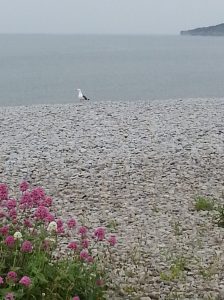
Where does inspiration come from then? For me it’s an overheard conversation, a piece of music, an insight into people’s lives through observation, a memory triggered by something or someone.
In a recent piece of writing, now nearing publication, I was inspired by a brief glimpse into someone’s life: a woman, sitting in the driver’s seat of a car parked in the drop-off zone at Heathrow airport. Her arms and head were resting on the steering wheel, and for the thirty seconds I observed her she didn’t move a muscle. Thoughts raced through my head. Was she tired after a long journey and having a quick nap before driving home? Upset because she’d dropped someone precious off at the airport? Waiting for someone? Dreading something? Would she be missed by someone? What was going on in her life that caused her to seemingly collapse over the steering wheel? I couldn’t see her face, only a glimpse of blonde hair interspersed with grey; I had no idea how old she might be, or what her thoughts were.
Another time, sitting in a cafe by the beach on the Mornington Peninsula to the south of Melbourne, I was fascinated by the antics of two women a couple of tables away. I couldn’t hear a word they said, but I mentally noted their dress, their mannerisms, their behaviour towards the waitress, their facial expressions and the way they gave the appearance of being friends but… was there a hint of a chill there? Was it rivalry? 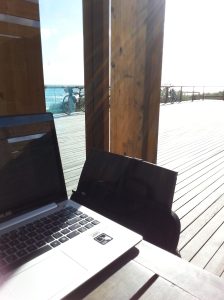
Maybe not, but I chose to make it so. And that is where observation turns into fiction, for that is what we writers do: we dream up scenarios and attribute personalities, families and friends, fun and laughter, problems, tragedies, and much more to the little observations we make each day and store away in the filing cabinets of our minds. We draw upon our own experience of life, or things we have read about or witnessed and in doing so we create wholly fictitious characters who live in a world which we control for them. After the two women in the beach side cafe left I opened my laptop and, ordering another coffee, I created a bitchy dialogue which has found a home in a travelogue I am writing.
Not every observation or flash of inspiration can be turned into fiction so promptly, however. Mostly, these snippets are stored away in a notebook, in a file on my laptop or simply in my own memory bank. Then it is simply a question of cataloguing the thoughts in my head: putting them into highly coloured filing cabinets in my mind, drawers clearly labelled, ready to be opened and brought into the light of day.
They say that memories are first processed in the amygdala and then, when that temporary storage has reached capacity, they are transported to more reliable and pertinent areas of the brain. So it is with the bursts of inspiration which come to me. As I write, I am persuaded to open a drawer in the green filing cabinet of my mind where past experiences are stored, or the yellow cabinet which draws on emotional memories. Or the pale blue one which contains strange anecdotes.
A chance meeting with a man in Melbourne a couple of years ago triggered off a memory of people I met at a campsite in Hungary in 1991 and reminded me of the story I had been told of their escape from behind the Iron Curtain some years earlier. The memories are rather hazy after such a long time, but the essence remains. There is no danger of anyone identifying themselves in any of the characters which emerge from these memories, as they are generally composites by the time I write about them, and secondly, my memory conveniently embellishes anything stored within it beyond all recognition.
Even so, I would like to extend my thanks to all those who, unwittingly, have provided me with inspiration for my writing. I will never know your names, I will never know what you were thinking or planning, but I will always be in your debt for giving me a framework on which to hang my fiction.
 P. S. Temple-Murray
I can picture you in the cafe, on the pebble beach and in that campsite in Hungary …filing furiously.
Looking forward to reading all you’ve got. ¯\_(ツ)_/¯
LikeLike
Thank you, Pat. I am now sitting in a busy shopping mall watching people. Already seen two quirky encounters!
LikeLike
Its fascinating to hear the stories behind your writer’s inspirations. You seem to conjure them up so easily! I love ‘people watching’, (I think there was once a book of that name) and the idea of wondering about their back story, and then putting it into novels – tweaked so no one will recognise themselves – is indeed an inspiration to others. Can’t wait until your novella is published!
LikeLike
Thank you Kaye! Before I retired, my day job required a great deal of observation and analysis of human behaviour. I guess it’s now second nature to people-watch, and such fun!
LikeLike