The well-travelled book?

Just pondering…..

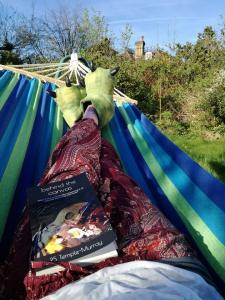
I guess this blogpost arose after I was sent this photo of my book ‘Behind the Canvas’  being read in a hammock in a garden in London. Please notice the footwear of the hammock-lounger….

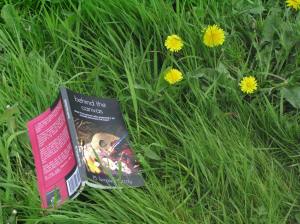
And that made me think: this is a book that wants to travel. So I am taking my copy with me wherever I go, and taking the opportunity to photograph it in some of the places one might want to relax and read a book.

Incidentally, I missed a trick recently when I drove from Wales to Scotland but didn’t take any photos in the heather… and it’s beneath me to photoshop my book into photos I did take of Scottish (not highland) cattle.

Sunday in mid-Wales

Well, you can’t tell this is mid-Wales, but it is. On a visit to the Royal Welsh Showground in Builth Wells, this is the spot where I ate my picnic lunch before starting Round 2 inside the Wonderwool sheds. In case you’re confused, Wonderwool is an amazing annual celebration of all things to do with wool. So: spinning, knitting, weaving, crocheting, felting and all those other country crafts which tend to keep us warm in winter. Here you can buy anything from hand-carved crochet hooks to whole fleeces with the names of the sheep or other woolly creatures on them. I bought some lovely dyed strands of a goat named Hugo, and quite a lot of an unnamed alpaca. I do all of the above crafts, but these offerings are destined for the spinning wheel.

But of course, it’s not all about the travels of ‘Behind the Canvas’  – it’s also about MY travels and the local colour I can pick up for future books. So watch this space!

Pantser or Snowflake – what kind of writer are you?

First of all, the Pantser

Yes, I know this is a strange expression, but it’s one I’ve come across a lot recently, and at the moment there’s a debate on one of the Facebook sites I follow about whether it’s best to do an outline of your book or simply fly by the seat of your pants. Somehow the latter makes you a ‘Pantser’. Apparently it’s a NaNoWriMo term and means you start your novel with only the basics, then let it flow. There’s not much to say about people who are Pantsers when it comes to writing, except that they just jump in and write, write, write.

Then there’s the Snowflake…

Now, this can be simply a brief one-sentence or bullet-pointed description or plan of each chapter. Or it can go deeper, and deeper until you have an outline which fills a lever-arch file. Of all the helpful books I’ve read and online tutoring I’ve taken advantage of, I favour the Snowflake method of planning your writing. It’s an easy to use structural crutch which can be used at various levels.

If you examine a snowflake under the microscope, you can see its intricate structure; if you use greater magnification you can see intricate structure within THAT structure… and so on… and so on. Randy Ingermanson, self-styled Mad Professor of Fiction Writing, has produced a plan which suits any sort of writing, although he seems to be promoting disasters and nail-biting themes. If you ARE writing a disaster novel, or a thriller, then this structure will keep you on track and your readers on tenterhooks!

Over the years, I have tried out both. I started by just being a Pantser, just writing, letting it spew out and occasionally redrafting and editing before consigning the particular work of art to a folder on my PC.

Then I began to realise that people spent years studying the art of creative writing and maybe I should too. So I delved into structure and became a student of the outline. That’s when I discovered the Snowflake Method. I learnt that you needed acts, rollercoasters, mid-points, on down to scenes within chapters, scenes which had to be either proactive or reactive. Then there was character development, with many a helpful worksheet to complete for each character so you knew, as you were writing, where he went to school, what her childhood dreams had been, what colour eyes, hair, what size shoe, favourite band, political leanings, hopes and fears and so on and so on. It proved too easy to spend hours and hours on planning rather than writing.

So… I try to find a happy medium and dabble in both.

My writing stash…

At the moment, lurking in folders on my PC (and on back-up USB sticks) I have:

  • one epic novel (about a quarter complete) minutely planned right down to the reactive scene, but leaving me no room for any sort of creative plot change without a huge rewrite;
  • one biography, a true Pantser, which I occasionally flow right into when the mood takes me and when I’ve done the historical research which is sometimes necessary (but that’s fun too);
  • one novel (first 10,000 words done) which is planned to a lesser degree in that I don’t subdivide into plot scenes but let the characters take the lead;
  • one children’s novel (two chapters done) which is a true Pantser in that even the basics are all in my head and not on paper;
  • my current novel (in the Fallout series) which is another Pantser although I do have an inkling of where it might be going… but I could be wrong;
  • a co-writing (with my daughter) novel which is still in the discussion stage but will probably need some sort of structure because there are two styles to take into account.

I know that I favour the Pantser model – and it’s certainly the easiest and possibly the fastest to write. My first published book, Behind the Canvas, is one such novel, and I was flying by the seat of my pants the entire (short) time it took to write. The redrafts and edits followed, of course. However, there’s a lot to be said for planning your novel with lesser or greater detail. Even if you don’t produce reams of intricate plans, you do begin to have that structure in your head after a while, and your writing (and I really mean MY writing!) will certainly benefit from that.

So where do you find yourself? Do you simply jump in or do you plan first?

‘Behind the Canvas’ – now available in paperback!

By the way…

‘Behind the Canvas’, the first book in the ‘fallout’ series, is now available on both Kindle as an eBook, and as a paperback. Both can be ordered online at Amazon.

I would be most grateful if you could leave a review. These do make a difference! Not just to my ratings on Amazon, but also as much appreciated feedback on what I could do to improve my work. One reviewer who has published on Amazon mentioned there was no way to contact me and this has now been added at the end of the paperback version. Many thanks for the tip!

This reviewer also wondered what happened to the characters later on in their lives… and maybe that will find its way into another book.

In the meantime, I have used this website to fill in some of the gaps for readers by giving them an insight into the early lives of Sadie, Mike, Jane and Alicia.

‘Behind the Canvas’ – Mike’s Backstory

‘Behind the Canvas’

is available for Kindle. The following is an interview with two people who knew Mike Alardyce, one of the main characters, in the years before the events which are described in the book.

Interview 1 – Annie Harper     

Interviewer:  Ms Harper, tell us about your connection with Mike Alardyce.

Annie Harper: I met him several years ago. We’re both in the same line of business, both accountants, although he has shot up the career ladder in a way I haven’t found possible.

Interviewer: So, did you work together?

Ms Harper: No, thankfully not. I have enough problems just competing with men in my own firm, without having to contend with an arrogant know-all like Mike. I’m not convinced he reached his great heights ethically, shall we just put it like that!

Interviewer: So in what capacity do you know him, if not professional?

Ms Harper: We’ve never worked together, but we have played together. One of my poorer decisions. We first met at a conference in Manchester in the 1990s. I caught his eye and that was that. It was many years ago now, but I’ve watched him ensnare young colleagues time after time. He’s a serial philanderer. I pity his poor wife; she must have had her work cut out being married to him. And I’m just sorry I ever met him in the first place.

Interviewer: You sound quite bitter!

Ms Harper: I admit to that. We had an affair that lasted two years and at the end of that period I left my husband. Mike promised to leave his wife; we were going to be together, we’d seen a lovely apartment. He let me go ahead and end my marriage then refused to keep his side of the deal.

Interviewer: Did you never think of contacting his wife and telling her about your relationship?

Ms Harper: Of course not! I couldn’t do that! I was angry with him, but didn’t want to hurt her any more than necessary. Any more than I wanted to hurt my husband more than necessary. No, Mike was a low-life. He never intended to leave her for me, he just strung me along. I discovered she had just given birth to twin boys and he was intent on playing happy families.

Interviewer: I’m very sorry. I hope you managed to sort things out with your husband.

Ms Harper: Of course I didn’t. I had cheated on him for two years so there was no making up for that. He was a lovely man. I didn’t know how blessed I was. He remarried and is apparently very happy.

Interviewer: And you? Are you happy?

Ms Harper: I am now. I’m in a solid relationship now but only after many years of unhappiness and depression – and guilt. I probably got what I deserved but it was galling to see Mike go from strength to strength – and continue to have affairs. I wonder if his wife ever knew?

Interviewer: Have you had an opportunity to speak to him since your affair ended?

Ms Harper: I’ve seen him at conferences and on courses over the years, but I steer well clear of him. He threatened me once, and I have to admit to being a bit fearful of him.

Interviewer: He threatened you? What kind of threats did he make?

Ms Harper: I called him out, warned another young girl about him, oh, about a year after we split up. He waited by my car one evening, outside my office. When I got to my car he pushed me up against it and told me if I ever interfered in his business again he would finish me off, he’d be watching me. He twisted my arm badly and broke my wrist. He was a monster.

Interviewer: Why didn’t you report him to the police?

Ms Harper: Have you met him? I was living on my own by that time. I was too scared to do anything. He knew where I worked, where I lived… it was too risky. I didn’t think the police could protect me. I didn’t even know if they would believe me – he always had answers for everything.

Interviewer: Could you sum Mike up in three words?

Ms Harper: Only three? Here goes: Deceitful; dangerous; ruthless.


Interview 2 – Tom Hadley

Interviewer: I understand you were at school with Mike. What was he like?

Tom Hadley: As young kids we were pretty close but that changed when we went up to high school. We were sort of friendly, being in the same class and all, but Mike sort of gravitated to a new set of friends. We both did Maths at ‘A’ level so I saw a fair bit of him in those lessons. He was good. Had a keen mind.

Interviewer: What about girlfriends?

Tom Hadley: Well, I never had any problems! Oh, you mean Mike? He was a bit of a charmer, seemed to have a steady stream, but he always dumped them, never the other way round. He was very confident of his good looks and looked for the same in the girls he went out with.

Interviewer: Would you say he was superficial in that respect?

Tom Hadley: Oh, very! If a girl had a mind of her own she didn’t get very far with him. He liked them pretty and clueless. I hear he married a really nice woman, though, so maybe he changed.

Interviewer: He has been described as deceitful; would you agree with that?

Tom Hadley: No, I wouldn’t have said so. He could be a bit tricky, wasn’t always above board with the girls, but deceitful’s a strong word. He wasn’t exactly trustworthy, I reckon. He’d always put himself first, before friends. Not very reliable.

Interviewer: Did you know anything about his family?

Tom Hadley: Well, yes. We all knew a bit about each others families, it wasn’t that big a place. His dad had been a miner, like mine. But then he lost his job, as so many did. A lot of families went to the wall at that point, or moved away to look for work. His mum was lovely. She always baked great cakes and pies. A good cook. I remember her from when we were in primary school. In those days I’d go round to their house and she always fed me. I liked his sister, too, she was a laugh. Had a real spark about her. I quite fancied her as a lad, used to see her around school when we were in our teens. Last I heard she got pregnant, left school and married a bookie. Shotgun wedding, I think.

Interviewer: When did you last see or hear from Mike?

Tom Hadley: Not since we both left school. I gave him my address – I got my first job in York straight from school – but I never heard from him again. My family moved away from the area so I never saw him or his family again. About twenty years ago I bumped into an old school friend who said he’d heard that Mike had got married after university. I don’t know where he heard it though.

Interviewer: Can you describe the Mike you knew in three words?

Tom Hadley: Mmm. It’s a long time ago. He might have changed a lot since I knew him. I’d say: charming; clever; a bit of an unknown  quantity, really. Sorry – more than three words!
 

‘Behind the Canvas’ – Alicia’s backstory

Interview 1 –  Dr Francine McDowell

Interviewer:  Dr. McDowell, you were Alicia’s headmistress for a time, is that right?

Dr McDowell:  That is correct. She came to us at Fairborough House School for Girls when she was thirteen or fourteen. Her father took on a practice in a neighbouring town and her mother was very keen to enrol her in our school. We had a waiting list, of course, but made an exception when we saw her very good grades. And, of course, we were told her mother had connections.

Interviewer:  Connections?

Dr. McDowell:  Yes. Unfortunately we did not check them out at the time, but took her at her word. They later proved to be false but by that time Alicia was doing very well with us. The school governors and I felt  it would be unproductive to insist on her removal. Also, we could not let the girl suffer for the actions of her mother.

Interviewer:  What was Alicia like as a girl?

Dr. McDowell:  She was very quiet when she first came. Barely spoke a word and found it difficult making friends among the other girls. But I have seldom seen such ambition in one so young. She was extremely competitive and single-minded – in sport as well as in her academic studies. Unfortunately, Alicia could be very disparaging, actually quite unkind, about others. She alienated quite a few girls during her time with us.

Interviewer:  Did she make any close friends?

Dr. McDowell: I do not believe she did. She attended a ten-year reunion dinner a few years ago, just before I retired, and we had great difficulty with the seating plan as no one particularly wanted her at their table. I think she was much better relating to the opposite sex. In the Sixth Form we liaised with a local boys’ school, St.Peter’s, and shared some lessons and facilities. Alicia always had a trail of boys after her. I remember …. oh.. it’s not important.

Interviewer:  No, please go on.

Dr. McDowell:  I don’t suppose it matters now. It was so long ago. There was talk of her flirting a lot, and stealing the boyfriend of one of her classmates. It caused a lot of trouble at the time and the girl in question, a silly young thing, attacked Alicia. All over a boy – such immature young people! We sorted it out eventually and separated the two girls, put them into different forms. Alicia was our star pupil – she got very good results and went to the university of her choice.

Interviewer: And what happened to the other girl?

Dr. McDowell:  I really don’t know. She left before her final exams, went to live with an aunt for a time, I was told. I don’t know why she left so hurriedly. Alicia was a difficult girl, I could see that, but she had so much promise, a great future in front of her. Her father was a perfect gentleman, a pleasure to talk to, but her mother could be very pushy and, of course, was not above fabricating an illustrious family.


Interview 2 – James Holloway

Interviewer:  Thank you for agreeing to talk to me, Mr Holloway. I understand Alicia worked for you after leaving university?

Mr Holloway:  Not exactly. She worked in the same firm, but we were just colleagues, although I was in a senior position.

Interviewer:  I see. And what was your impression of this young Alicia?

Mr Holloway:  She was absolute poison.

Interviewer:  Oh… right! Um… but why was that? What happened…?

Mr Holloway: I was charged with being her mentor when she first came to us. Showing her the ropes, that kind of thing, helping her see how our firm operated. She managed to get me demoted and herself promoted into my position. She was a nasty piece of work, and I wasn’t the only one who suffered.

Interviewer:  Oh really? What did she do?

Mr Holloway:  She was sneaky. She flirted with the junior partner and passed on false information to him. We could never find out exactly what she’d said about us, but it changed the climate in the firm. I was first aware of it when I noticed worrying glances from my colleagues. And a dismissive atmosphere in meetings. Nothing you could put your finger on until it was too late. Some confidential files which should never have left the premises went missing from my office and were later found in the boot of my car.

Interviewer:  Was that Alicia? Really?

Mr Holloway:   Yes. All her work. I was disciplined and lost my seniority as a result.

Interviewer:   That’s dreadful! You mentioned others who suffered…

Mr Holloway:  Another colleague was accused of stealing from her desk. There was no proof and it was her word against his, but he ended up resigning. The junior partner, who was newly married, rumbled her eventually but Alicia met up with his wife and I believe a divorce followed. She was bad news. I’m glad she was encouraged to move on. I got my position back, of course, when it all came out, but my health suffered for a time.

Interviewer:  Where did she go after that?

Mr Holloway:  I heard she moved to somewhere near Bristol. The firm was so intent on getting rid of her that they gave her a glowing reference. That was nine or ten years ago, of course. I heard she moved up the ranks quite quickly but have no idea where she is now.


‘the fallout series’ – Book #2… delving into marriage

Well, book #2 is in the process of being written, and unlike ‘Behind the Canvas‘ which was inspired by the actions of an unknown person I observed, the inspiration for the title of my next book came from a road sign.

An aside: several years ago I started researching the history of Australia and parts of the UK with a view to writing a family saga. I found a title that suited my brainchild exactly. Without planning it, I began to write the story around the title. That book (maybe a trilogy) will take some more time before it’s finished – more of that in another blogpost. Maybe a ‘sneak peek’ later….

But to get back to the second book in ‘the fallout series’, I have my son to thank for its title.

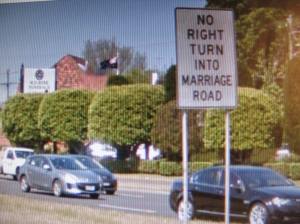
Just south of Melbourne CBD the Nepean Highway leaves the city and threads its way through suburbs and down onto the Mornington Peninsula. Sometimes it’s a three-lane highway in each direction, sometimes it’s just a country road. As it snakes between Brighton East and Bentleigh there is a big intersection, preceded by a sign that reads: ‘No Right Turn into Marriage Road’.

Driving home from the city one day this was pointed out to me by my son, along with the prominent sign for a funeral home on the corner of the Nepean Highway and Marriage Road. Plenty of material there for a tragi-comedy, we thought. But it was the sign pictured here which imprinted itself upon my brain and soon we were imagining scenarios for a book with the title: ‘No Right Turn into Marriage.’ By the time we got home some of the ideas had taken hold – and I am now engaged in writing about (yes, you guessed it) –  marriage. Or rather, a group of marriages.

Again, like ‘Behind the Canvas’, this book will be written from several perspectives. Marriage can mean different things to different people; expectations can differ wildly; a marriage can change irrevocably with the passing of time. These are just three issues which will find their way into ‘No Right Turn into Marriage’.


Behind the Canvas – Jane’s backstory

Read a little about Jane’s background here:

Interview 1 – Andrew, Jane’s brother.

Interviewer:   You’ve known Jane all your life, is that right?

Andrew:   Yes, of course! She’s two years older than me so she was always around.

Interviewer:   So what kind of childhood did you have?

Andrew:   A very happy one. Our parents were quite strict – father more so than mother – but somehow we had a lot of freedom. When we lived in the country we were like wild things! We’d eat a huge breakfast, pack some bread and cheese into greaseproof paper bags (there were stacks of them in the kitchen) and head out for the day. We’d climb trees, build tree houses, dam streams, clamber over rocks, fish in streams and off the rocks, go out rowing in leaky boats… oh the list is endless. We had a brilliant childhood. And Jane was usually in charge, being the eldest. I realise now what a lot of responsibility she carried.

Interviewer:   But then she went missing from your lives for a long period, isn’t that right?

Andrew:   Well, yes and no. She met Alex at university and brought him home a couple of times. Helen and I loved him, he was so kind, so easy to talk to. We were stroppy teenagers at the time and appreciated someone who didn’t judge us, who understood our points of view. But Father, well, that was a different story. He felt that Alex wasn’t good enough and he made no bones about showing it. Jane is very like Father in some ways; they are both opinionated, both very stubborn. So of course they clashed, time and time again. Mother really liked Alex and was a good influence on Father, most of the time, but even she couldn’t calm him down. Especially after Jane announced that she and Alex were getting married.

Interviewer:   And they obviously DID get married!

Andrew:  Yes. Father put his foot down, threatened Jane, brought all sorts of hell and damnation down on her head. So she and Alex went off and did the deed on the quiet. I have a sneaky suspicion Mother attended their wedding, but till her dying day she never admitted to it. I’ve always been in touch but they spent so many years abroad and we never saw them much. But we’re as close now as we were as children.


Interview 2 –  Meg Staines

Interviewer: I understand you’ve known Jane for a number of years? When did you first meet?

Meg: I’ve known Jane and Alex for almost twenty years, such a lovely couple. Way back then I was struck with how close they were, and I have to say, they’ve never lost that. Let me see, we first met at a reception at the Embassy in Bangkok. I was a visiting journalist, covering a series of celebrity tennis matches at the Royal Bangkok Sports Club, and they were teaching at a British school in the city. Alex was assistant headteacher and Jane taught English, I think. We became firm friends and have kept in touch ever since.

Interviewer: But surely a difficult friendship when you rarely saw each other?

 Meg: Not really. They would always visit me in England when they returned every other summer. I lived near Oxford in those days and they loved the countryside around. I believe Jane had family in the north somewhere – now she was a bit secretive about that and of course I never pressed her. My investigative journalism stops when I’m at home! Anyway, they moved to Europe soon after I met them as Alex caught malaria and was very ill. He headed up a little English school in Hungary for a few years, then they moved to Germany and I often visited them there.

Interviewer: So when did Jane return to the UK?

Meg: Quite a few years ago – you’d have to ask her. I think it was just before my daughter was born. Yes, about six, nearly seven years ago, because Jane and Alex are godparents. They’ve never had children of their own and spoil Grace to bits. I was so pleased that they chose to settle down not far from me and my family. We see quite a lot of them, actually, and Grace loves them to bits. Jane is now a writer and has dedicated one of her books to Grace. Such a lovely thing to do.

Interviewer: What would you say are Jane’s strengths and weaknesses?

Meg: What a strange question! Well, her strengths are loyalty, honesty, compassion. She will do anything for her friends and for anyone she considers vulnerable and in need of help. She’s a wonderful person, quite selfless in many ways. As for her weaknesses, I have to say she’s a little too fond of neat whisky. She can also be very, very stubborn and unbending when she really believes in something. And she doesn’t suffer fools gladly. I think that last one is a strength, actually.

Interviewer: Do you know anything about her earlier life?

Meg: Actually, now you mention it, I know very little. It’s not that she’s secretive, it’s just that it’s never come up in conversation. They spent a lot of time with Alex’s mother, I know that. Oh wait! Sadie would talk about her brother Andrew and a sister, I believe. She dedicated one of her books to Andrew’s children, I remember now.


Do you want to find out more?  ‘Behind the Canvas’ is available for Kindle at Amazon.


‘Behind the Canvas’ – Sadie’s Backstory

‘Behind the Canvas’ begins with Sadie, the wife whose marriage has just fallen apart. I hope the following interviews will give you a greater understanding of her character.

Interview 1 – Dr. Cox    

Interviewer: Dr Cox , I understand you first met Sadie when you were both children?

Dr Cox: Well, yes, I suppose so. Her mother was a receptionist at my father’s GP surgery and when I was in my teens she was still in junior school. I didn’t know her very well though, she was just a kid. I suppose I became more aware of her when she was about fifteen and I was a medical student helping out my father during the holidays. Just admin and stuff.

Interviewer: Ah, so what can you tell me about her?

Dr Cox: She was very quiet, but friendly. She would come to the surgery after school and make cups of tea for us all in the kitchen. Then she would settle down and make a start on homework until her mother finished work.

Interviewer: She was a good student then? Did she have many friends?

Dr Cox: I don’t know anything about her friends. She and her mother were very close. I quite envied her as I never felt that close to either of my parents. Her dad had walked out on them a few years earlier and left them in dire straits, according to my father. I imagine that brought them together. It was lovely to see how affectionate they were. Sadie was always gentle and kind and would do anything for anybody. Very like her mother. She took great care of her mother throughout her illness, couldn’t do enough for her. It was such a tragedy, a young girl like Sadie being totally on her own, no family at all. My father always said she was wise beyond her years, very independent, but somehow also needy. She’d had to grow up fast and take control of her life in a way that most eighteen-year-olds never had to.

Interviewer: Did you ever see her after her mother died?

Dr Cox: No. But she kept in touch with my father for some years. She felt indebted to him for passing on my old car to her after I went abroad. I understand she drove her mother all over the place in it in the months before she died. She went off to uni and I often wondered what became of her. My father said she married someone and then contact petered out. He was a bit concerned. He felt she might be rather vulnerable. Sorry, I can’t tell you much more than that.


Interview 2 – Hazel Fergusson

Interviewer: You were at university with Sadie, is that correct?

Hazel: Yes, that’s correct. Good grief – that was years ago now! More than thirty years! We met on our first day there and became very close friends. Until she met Mike, that is.

Interviewer: Oh. And what happened then?

Hazel: I guess we drifted apart. I was seeing someone too and we didn’t seem to have the same amount of time for each other anymore. We shared a house in our second and third years but  scarcely saw each other after she met Mike. We both had finals too so were studying pretty hard.

Interviewer: Did she seem happy? What did you think of Mike?

Hazel: Oh, she was totally in love with him. And he with her, I would say. He admired everything about her and they were inseparable. Sadie had no family at all, she was all alone in the world and I did worry that she was jumping into a relationship with Mike too quickly, for the sake of security. She was definitely a people-pleaser and more than anything she wanted a family around her. I personally felt that, unlike me, she hadn’t had enough experience of men to make such an important decision in her life. She’d never even had a boyfriend before uni. I tried talking to her, but she was set on Mike and I had to respect that.

Interviewer: Did you see her much after university?

Hazel: Yes, for the first year and a bit. She was still studying – some sort of art course – and working part-time and they’d found a gorgeous little cottage. I went to a few parties there. She was a great cook and always a lot of fun. She was the happiest I’d ever seen her! Mike seemed nice but I saw another side of him now and again. There was something odd, secretive about him… and I could never work out why I didn’t trust him entirely. Anyway, I lost touch after I moved to New York; I was offered a fabulous job there and met my husband soon after so I haven’t been back to the UK much since my parents passed away.


Interview 3 – Brian Phelps

Interviewer: So, Mr Phelps, how did you know Sadie?

Brian: Oh please, call me Brian. Well, Sadie and I grew up together. We were next-door neighbours, semi-detached, and our parents were friends. There was a hole in the hedge between our back gardens and we used to sit in this sort of cave and have secrets. What do you want to know about her?

Interviewer: How old was she when you first met?

Brian: About zero probably! We were babies together. I don’t remember a time before Sadie. Our mothers would walk us together in our pushchairs to the park, we treated each other’s houses as our own. I don’t reckon our parents ever had any babysitting problems! But they moved away when I was about twelve, or maybe thirteen – I think I’d done about a year in high school – and although our mothers kept in touch, I never saw Sadie again.

Interviewer: Why did they move away?

Brian: I remember my parents talking about it, and going silent when I walked into the room. Her father, Dave, just disappeared one day, just didn’t come home from work. There were police visits now and again and in the end, after a couple of months, Sadie and her mother moved away. It was years before my parents told me what really happened.

Interviewer: So what did happen?

Brian: Apparently Dave had another woman somewhere else – had had for years. My dad sort of knew about it and didn’t approve, but never spoke of it before Dave left. My mother gave him hell, called him an accomplice, slapped his face. She was very upset and tearful and I remember Dad just hugging her and smoothing her hair while she cried. At that time I had no idea what had happened, apart from the fact that Sadie’s dad was missing. Anyway, the police tracked him down eventually but he stayed with the other woman, refused to come home. An utter bastard. It made things very hard for Sadie and her mum. They had no money, couldn’t pay the mortgage and I think the house was repossessed. So they moved away, Sadie went to another school and I never saw her again.

‘Behind the Canvas’ is available on Amazon for Kindle


Behind the Canvas ~ the backstory of each character

‘Behind the Canvas’ gives us a glimpse into a brief few months in the lives of four people. Three of these characters had a backstory which culminated in the events described in the book. The fourth character, more of an onlooker, was drawn in because she too had a history which made her empathetic and supportive to others.

Picture of 'Behind the Canvas' bookcover

Through a series of interviews with people who knew them as children and young adults, I hope to explore with you how their past experiences and very different personalities ultimately brought them to a place where certain events occurred, changing their lives for ever.

Over the next few weeks these interviews will be published here. I hope they will provide you with a greater understanding of the characters, and why they were motivated to act as they did.

‘Behind the Canvas‘ is currently available as an eBook from Amazon.


Writers’ Inspiration and the Filing Cabinets of the Mind

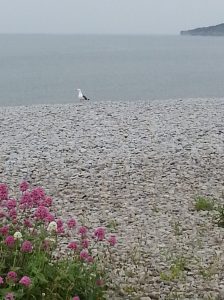
A friend called Kaye (author of “The Truth About Amber” among other books) once told me that lying in a water-filled chamber listening to soft music, which slowly fades to silence, was a gateway to writers’ inspiration. I can understand that, totally, as I find I can easily lose myself in thought in the quiet times, the times when no outside distractions interfere with what is tumbling around in my head. A pebble beach near my home is a favourite quiet spot. But I can sometimes get the same detachment from the world when I am sitting on a long-distance coach or train, or waiting for two hours in departures at some airport. At times like these, even the surrounding noise cannot pierce my thoughts.  Pebble beach

Where does inspiration come from then? For me it’s an overheard conversation, a piece of music, an insight into people’s lives through observation, a memory triggered by something or someone.

In a recent piece of writing, now nearing publication, I was inspired by a brief glimpse into someone’s life: a woman, sitting in the driver’s seat of a car parked in the drop-off zone at Heathrow airport. Her arms and head were resting on the steering wheel, and for the thirty seconds I observed her she didn’t move a muscle. Thoughts raced through my head. Was she tired after a long journey and having a quick nap before driving home? Upset because she’d dropped someone precious off at the airport? Waiting for someone? Dreading something? Would she be missed by someone? What was going on in her life that caused her to seemingly collapse over the steering wheel? I couldn’t see her face, only a glimpse of blonde hair interspersed with grey; I had no idea how old she might be, or what her thoughts were.

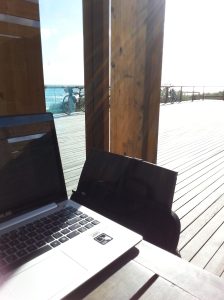
Another time, sitting in a cafe by the beach on the Mornington Peninsula to the south of Melbourne, I was fascinated by the antics of two women a couple of tables away. I couldn’t hear a word they said, but I mentally noted their dress, their mannerisms, their behaviour towards the waitress, their facial expressions and the way they gave the appearance of being friends but… was there a hint of a chill there? Was it rivalry?   View from the beach side cafe while working on my laptop.

Maybe not, but I chose to make it so. And that is where observation turns into fiction, for that is what we writers do: we dream up scenarios and attribute personalities, families and friends, fun and laughter, problems, tragedies, and much more to the little observations we make each day and store away in the filing cabinets of our minds. We draw upon our own experience of life, or things we have read about or witnessed and in doing so we create wholly fictitious characters who live in a world which we control for them. After the two women in the beach side cafe left I opened my laptop and, ordering another coffee, I created a bitchy dialogue which has found a home in a travelogue I am writing.

Not every observation or flash of inspiration can be turned into fiction so promptly, however. Mostly, these snippets are stored away in a notebook, in a file on my laptop or simply in my own memory bank. Then it is simply a question of cataloguing the thoughts in my head: putting them into highly coloured filing cabinets in my mind, drawers clearly labelled, ready to be opened and brought into the light of day.

They say that memories are first processed in the amygdala and then, when that temporary storage has reached capacity, they are transported to more reliable and pertinent areas of the brain. So it is with the bursts of inspiration which come to me. As I write, I am persuaded to open a drawer in the green filing cabinet of  my mind where past experiences are stored, or the yellow cabinet which draws on emotional memories. Or the pale blue one which contains strange anecdotes.

A chance meeting with a man in Melbourne a couple of years ago triggered off a memory of people I met at a campsite in Hungary in 1991 and reminded me of the story I had been told of their escape from behind the Iron Curtain some years earlier. The memories are rather hazy after such a long time, but the essence remains. There is no danger of anyone identifying themselves in any of the characters which emerge from these memories, as they are generally composites by the time I write about them, and secondly, my memory conveniently embellishes anything stored within it beyond all recognition.

Even so, I would like to extend my thanks to all those who, unwittingly, have provided me with inspiration for my writing. I will never know your names, I will never know what you were thinking or planning, but I will always be in your debt for giving me a framework on which to hang my fiction.